

Latex vs Nitrile Gloves: Choosing the Right Gloves for Your Medical and Industrial Needs
2026-06-16 09:41:46
In medical, laboratory, and industrial settings, gloves are one of the most fundamental pieces of personal protective equipment (PPE).Latex gloves and nitrile gloves are the two most mainstream disposable glove products on the market. However, many procurement professionals and end users are often confused: which one should you choose? This article provides a comprehensive comparison across six dimensions — material, elasticity, chemical resistance, allergenicity, durability, and cost.
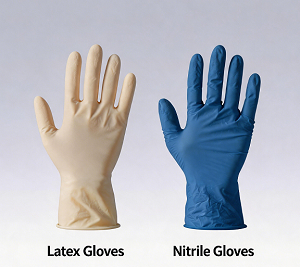
1.Material Source
Latex gloves are made from natural rubber latex, derived from the sap of Hevea brasiliensis (rubber trees). Natural latex gives gloves excellent elasticity and tactile sensitivity, making them highly favored in medical procedures requiring high dexterity — such as latex surgical gloves and latex examination gloves.
Nitrile gloves are made from synthetic rubber — nitrile butadiene rubber (NBR, a copolymer of acrylonitrile and butadiene). It is a petroleum-based synthetic material that contains zero natural latex proteins, thereby fundamentally eliminating latex allergic reactions.
2.Pros & Cons Comparison
Latex Gloves-Pros:Superior elasticity and tensile strength; excellent tactile sensitivity for fine manipulations; relatively better biodegradability; lower production cost.
Latex Gloves-Cons:1%-6% of the population risks latex protein allergy; poor resistance to oils and organic solvents; prolonged wear may cause skin irritation; relatively shorter shelf life.
Nitrile Gloves-Pros:Latex-free, zero allergy risk; excellent chemical and oil resistance; puncture resistance 3-5 times stronger than latex; longer shelf life (typically 5+ years); textured surface options available for better grip.
Nitrile Gloves-Cons:Slightly less elastic than latex; tactile sensitivity not as refined as natural latex (though premium nitrile has greatly improved); higher production cost; non-biodegradable.
3.Application Scenarios
Latex gloves are recommended for: surgical procedures, clinical examinations, dental treatments, low-risk laboratory work, and food processing.
Nitrile gloves are recommended for:chemical experiments and processing, automotive repair and mechanical work, cleaning and disinfection tasks, high-risk medical environments (e.g., infectious disease units), and any contact with oils or solvents.
4.Cost Comparison
From a unit-price perspective, latex gloves are typically 20%-40% cheaper than nitrile gloves. However, thanks to higher puncture resistance and durability, nitrile gloves may have a lower cost-per-use in high-turnover scenarios. In recent years, as nitrile raw material prices fluctuate and production capacity expands, the price gap is narrowing. We recommend performing a total cost of ownership (TCO) analysis based on your actual use case.
5.Summary & Recommendations
There is no "best" medical glove or industrial glove— only the most suitable one. If you and your team have no latex allergy history and your operations do not involve oils or strong chemicals, latex gloves offer a cost-effective and efficient solution. If chemicals, grease, or allergies are a concern, nitrile gloves are the safer, more professional choice.Hebei Boran Medical Technology Co., Ltd. Offers latex v nitrile gloves products to meet the protection needs of different industries and levels. Contact us for samples and selection guidance.