

Why Do Nitrile Gloves Feel Sticky? A B2B Quality Control Guide
2026-07-08 14:13:48
If your batch of nitrile gloves feels tacky—or the gloves stick to each other—don’t brush it off as “normal.”
In the disposable glove industry, sticky or tacky surfaces are rarely harmless cosmetic issues. More often, they indicate deeper manufacturing or stability problems: unstable formulation, incomplete curing, or inadequate storage conditions. For B2B buyers, this matters greatly: glove stickiness does not only affect comfort, but can also compromise barrier protection and overall performance.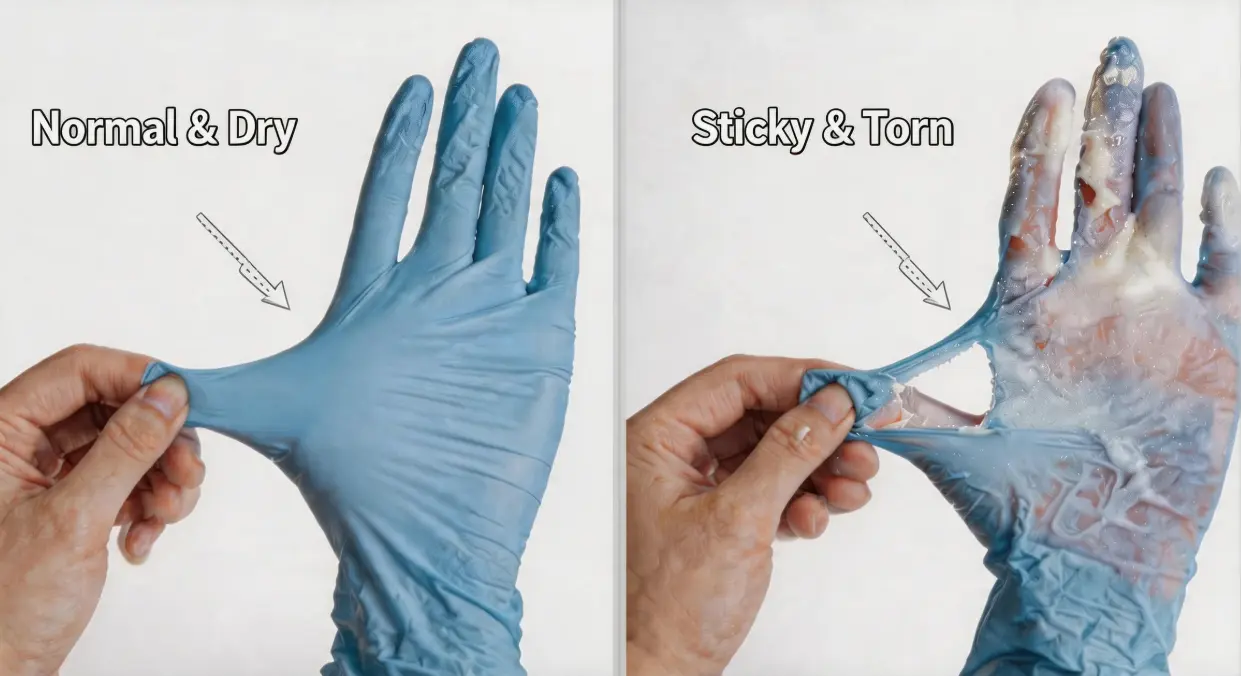
The 4 Most Common Causes of Sticky Nitrile Gloves
1. Curing Process Imbalances
During manufacturing, nitrile gloves go through curing—a chemical cross-linking process that defines strength, elasticity, and surface texture.For reliable medical grade nitrile gloves, consistent curing is essential.
· Under-cured gloves may feel sticky or soft, tear easily, show poor snap recovery, and carry a strong chemical odor.
· Over-cured gloves, by contrast, become hard, brittle, and prone to cracking.
Sticky surfaces often trace back to subtle but critical process variations: mold temperature, coagulant concentration, pH level, or polymer viscosity. When these parameters drift out of the acceptable range, surface defects and tackiness are likely to occur.
2. Plasticizer Migration
Plasticizers are sometimes used to improve softness and flexibility. However, if the formula is poorly balanced or incompatible additives are used, plasticizers can migrate to the surface over time.
The result is an oily, tacky film that not only feels unpleasant, weakens chemical resistance, and shortens the shelf life of the gloves.
3. Improper Storage & Transportation
Even well-produced gloves can become sticky if exposed to poor storage or shipping conditions.
Condition | Effect on Gloves |
Above 40°C (104°F) | Accelerated aging, leading to tackiness or stiffness |
High humidity | Surface stickiness and increased microbial risk |
Direct sunlight | UV degradation, discoloration, and surface tack |
Excessive stacking | Gloves may fuse together and tear when separated |
Before concluding a production defect, always review whether warehousing or shipping environments may have contributed to the problem.
4. Residual Lubricant or Contamination
Residual release agents, lubricants, or moisture left during production can also create a sticky or slippery film, especially when combined with high humidity during storage.
Proper storage is key to maintaining disposable glove quality.
Sticky Gloves: Process Defect or Storage Issue?
Use this quick-reference guide to help identify the root cause during inspection:
Observation | Likely Process Defect | Likely Storage Issue |
Batch pattern | Entire batch feels sticky | Only partial (top layers, sun-exposed areas) |
Odor | Strong chemical smell | Mild or no odor |
Packaging | Intact but sticky | Deformed, damp, or discolored |
Stretch behavior | Tears easily, shows uneven whitening | Retains normal elasticity |
Simple Field Test:
Gently stretch the finger section.
· Uneven whitening + stickiness → Possible under-curing
· Sticky but remains elastic → More likely storage or plasticizer migration
What High-Quality Nitrile Gloves Should Feel Like
High-quality nitrile gloves should meet these industry standards:
· Odor-neutral or very mildly scented
· Smooth, clean, and free of surface grit
· Dry to the touch, easy to don
· Consistently elastic — never sticky
Reliable manufacturers verify each batch through visual inspection, physical testing (tensile strength, elongation), and chemical resistance before shipment. Top brands emphasize non-sticky, comfortable wear as a core quality indicator, because dryness and comfort are not extras—they are essential signs of a well-made product.
Buyer Checklist When Stickiness Appears
If you notice tackiness during incoming inspection:
1. Check other cartons from the same batch to see if the issue is widespread.
2. Inspect packaging for signs of moisture, heat damage, or sun exposure.
3. Request the batch’s test reports, including tensile strength and aging resistance.
4. Ask your supplier about curing temperature and dwell time parameters.
5. If the problem is batch-wide and related to production, request a replacement shipment—don’t compromise on quality or user safety.
Final Thought for B2B Buyers
Stickiness is not a minor detail—it is a symptom of quality inconsistency.
For professional users, non-sticky performance is non-negotiable. If a glove fails this basic standard, it may point to broader risks: unreliable protection, unstable formulation, or inconsistent batch control.
Choosing manufacturers who maintain strict oversight of curing precision, formulation stability, and final inspection helps you avoid sticky gloves—and secure consistent, trustworthy performance in every shipment.
About BORAN Medical
BORAN Medical is a China-based B2B manufacturer of high-quality disposable nitrile and PVC gloves, serving hospitals, distributors, and industrial clients worldwide.
✅ ASTM D6319 & EN 455 certified
✅ Stable formulations with minimal batch variation
✅ Full factory transparency with production photos and videos available
✅ Long-term supply agreements with stable pricing